Monday, March 30, 2015


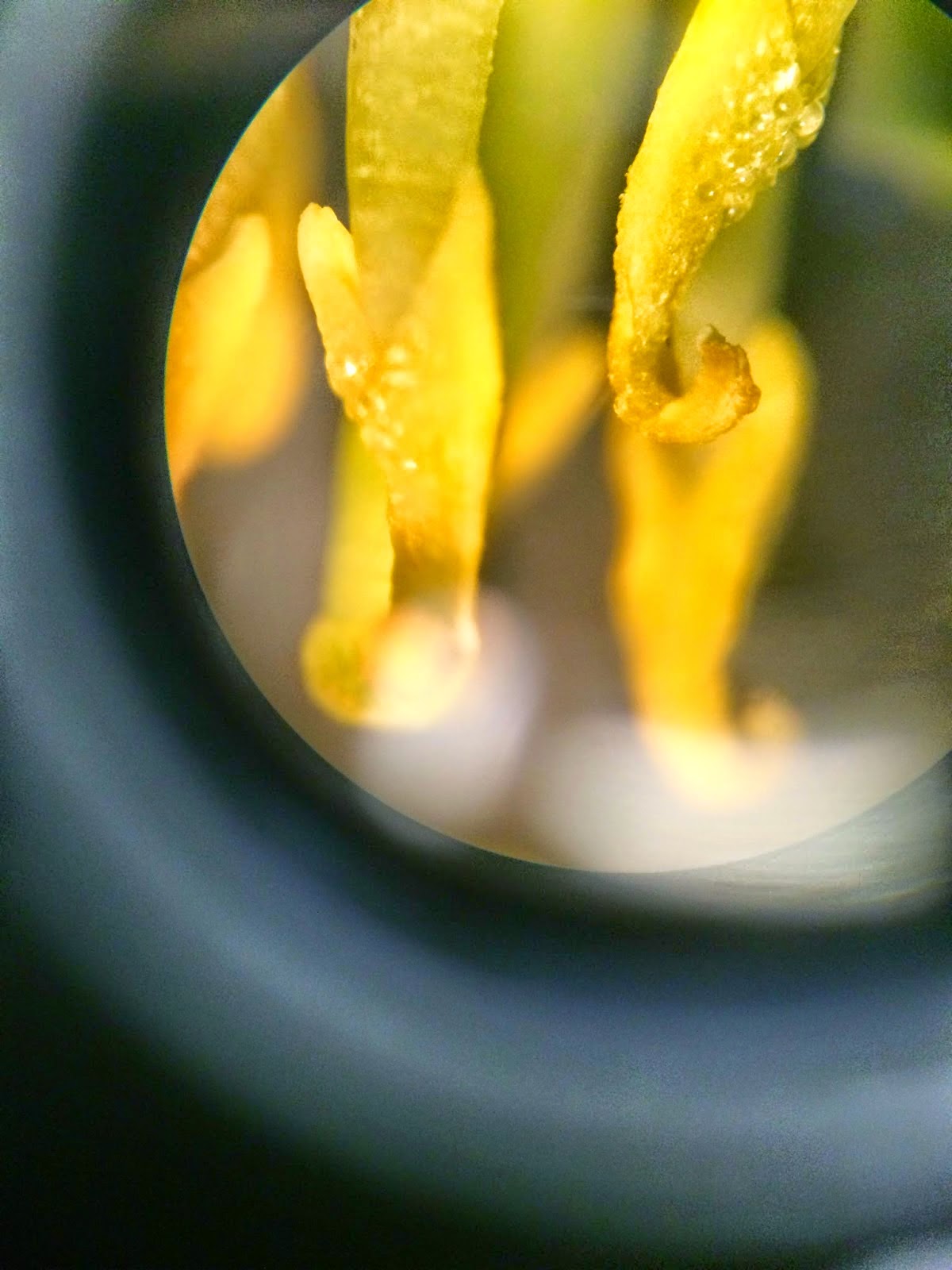
 This image shows anthers surrounding a stigma. They are all part of the same flower. When both male and female parts appear in the same flower, the flower is said to be perfect. In some species of flowering plant, the male and female parts are located in separate flowers (some flowers are male, some are female), and yet another situation is when the male and female flowers are on entirely separate individuals (some plants are male, some are female)
 Here is a view (40x) of the male reproductive anatomy of a flower, known as the stamen. It has a stalk called the filament coming up from the base of the flower and at the end of this stalk is a part called the anther. This portion of the stamen produces and releases pollen grains, which contain the plant's male gametes (sperm cells).

This is a view (40x) of the female anatomy of a flower called the carpel. The carpel consists of a stalk called a style with a sticky tip called a stigma. It is this sticky tip to which pollen grains adhere (get stuck).
This is a picture of a flower that has had all of the parts stripped away (sepals, petals, stamens, and the top of the carpel) except the ovary (the large green tube on the right), which has been sliced open and has tiny ovules (immature, unfertilized seeds) spilling out--one of these ovules can be seen to the left of the ovary.

#10: Anthers and Stigmas and Styles, Oh my


This is the stamen where the pollen is made. Each flower has many stamens
Shown is the part of the stamen called the anther. 
This is the part of the carpel called the stigma. It is where the pollen mainly will land.
This is part of the carpel called the ovary. were the to be seeds are stored before pollination.
 Look you can see inside.
The Pollen can be carried by The wind , bugs , birds, mammals, or even humans.Once the pollen reaches the stigma pollen tubes carry it down to the ovary. where the it goes into a seed..

Sunday, March 29, 2015

Blog Post #10 - Anthers Stigmas and Styles, Oh my


This is a picture of anthers surrounding the stigma. They are different reproductive parts of the  flower. When a flower has both male and female parts, it is considered perfect. With some flowers, the male and female parts are located in separate flowers, but with other flowers, the male and female plants are completely different, such as with lupine.


This is a view (40x) of the female anatomy of a flower called the carpel. The carpel consists of a stalk called a style with a sticky tip called a stigma. It it's the sticky tip to that the pollen grains stick to.
Here is a view (40x) of the male reproductive part of a flower, known as the stamen. It has a stalk called the filament that comes up from the base of the flower, and at the end is the anther. This part of the stamen makes and releases pollen, which hold the plant's male gametes.
This is a picture of a flower that has had all of the parts stripped away except the ovary, which has been cut open and has tiny ovules still inside of it, and some of these ovules can be seen still inside of the ovary.
The plant uses all of these parts to reproduce. It uses the stamen to spread pollen, and fertilize the carpel. The pollen is spread in many different ways, such as through bees. The pollens sperm goes down the stamen and into the ovary, fertilizing the ovules.

Friday, January 30, 2015

Gattaca Essay

        The main theme in the movie GATTACA is that animals can live symbiotically without adapting to be that way. The relationship between Vincent and Jerome exemplifies that. 
        Jerome provides Vincent with his DNA so Vincent can act like him, and in return, Vincent supports Jerome financially and physcologically. When Vincent leaves to go to Titan, Jerome can no longer live on in a symbiotical relationship, so he commits suicide.
This is the reason why animals can live in a symbiotical relationship, and the ones that do cannot live without it.

Thursday, January 29, 2015

Blogspot #9 A Matter of Seletion

The biggest characteristic of my Brassica oleracea is its elevated length and its green like spiky. It is also very unique because its has swirled,bumpy leaves.I think its distinctive form is because of there surrounding.

Tuesday, January 27, 2015

A Matter of Selection

Q1

The part of brassica oleracea that differs the most is the heads of leaves. In broccoli, there are “heads”, in most cabbage there are big, veiny leaves that wrap around the plant, and in kohlrabi there are long stems with long, jagged, dark green leaves. Overall they differ quite a bit from plant to plant. The characteristics they seem to have great variety of are shape and size. The romanesco plant has very pointy, small, symmetrical leaves, whilst the kohlrabi is like a radish with long leaves on the top. 

Who Wants to Live a Million Years: Analysis of a Natural Selection Simulation

It took me a few tries to win a game, mostly because I didn’t know how to play it at first, but after a while I started winning about ¼ times. I picked the most different ones I could find so there could be lots of genetic diversity. One thing I saw that relates to genetic drift is that sometimes a volcano would erupt, or a meteor would hit earth. The dominant ones were obviously long legs or long necks; getting food from tall fruit plants or running away from predators. Cold conditions: fur/hair on head/body. Hot conditions: No fur or hair on any part of the body. New large predator: need long legs for running away. New tall food source: long necks. Three improvements that they could add to make this simulation more realistic: Other species interrupting with them, required constant source of water/food, and to make time pass slower.

#9: A Matter of Selection

Why does Brassica oleracea have so many variates  that have so many different traits yet are of the same descent? That is likely because of selective breeding or when humans artificially select which plants breed together based on their phenotypes.  descent with modification can happen because of  mutations that lead to natural variations.

Friday, December 12, 2014

One of a kind: The wonders of Biodiversity

The plant we are using for this is Romanesco, which is similar to cauliflower. To tell what the chances are for baby plants to get certain traits, it's best to use a punnett square. The baby plants receive traits from their parents so they should have similar traits. The plants look different because they followed a certain genetic pathway enough so that they look much different than other types in the species.

How does your garden grow?

The plant grows bigger/gains more biomass by taking water and nutrients from the soil and makes more cells; in simpler terms, the plant takes things from outside, absorbs them, and grows bigger. If it needed more of those enzymes, it would absorb more nitrogen from the soil. Enzymes are in the protein bio-molecule group.

Living or Not

The plants have grown a lot since I last checked them, and they seem to be doing okay. Plants are a living thing because they grow and produce things like oxygen. If you do not give them enough water, sunlight or soil with lots of nutrients, then they will start to limp over and eventually die. The appearance has changed a lot as well, from being a small seed into a small stem with leaves and eventually into a full grown plant. You could measure the amount of things it requires to survive over time as it gets bigger in size.

Thursday, December 11, 2014

An Ecological Analysis of the Garden and your Plants

1. Biotic factors: Sunlight, nutrients from the soil, temperature. Abiotic factors: 
2. They are growing over each other, and trying to grow taller. They are most likely fighting over sunlight.
3. Whoever gets ahead faster. Yes and no, if they are trying to fight over sunlight it's obvious, but for other reasons it might not be as obvious.
4. Trying to grow away from each other or onto other things. It effects how tall/thick it is.
5. Primary succession, the seeds are bought and put in the garden, instead of dying and putting more seeds in.

Thursday, December 4, 2014

Biogeochemicals Cycles and Your Plants

1. Since I last checked, they got taller and the leaves started to grow outwards.
2. They take a part in the nitrogen cycle by taking it in from the soil.
3. When consumers produce waste or die, it puts nitrogen back into the soil and the cycle continues.

Tuesday, November 18, 2014

Biogeochemical Cycles and our Plants

Our romanesco, has not grown that much bigger, and there are a lot of bug eaten holes in them. Plants play a role in the nitrogen cycle, they absorb nitrogen from the soil. So when plants are eaten the creature that eats it it drops droppings with nitrogen that returns to the soil. Also when the plant dies the nitrogen returns to the soil then too. Plants need carbon too, so when a air breathing creature breaths out carbon. A plant breathes it in and expels out oxygen. Plants also play a role in the water cycle, when it rains plants pull up water through their roots, then some of the the water is evaporated out through the leaves. The water that is evaporated floats up into the atmosphere, until it rains.

Thursday, September 11, 2014

Cris's Bio

My name is Cris Castillo. I live in Los Angeles, Mexico, Utah, and San jose. yes, I have grown food. When I go to Mexico I grown tomatoes and corn. My Dad know gardening and my mom and some of my family.

Ariyanna's bio

My name is Ariyanna Carrasco and I have lived in San Jose my whole life.
I have gardened before, my family and I grew tomatoes,lettuce,lemons and many others thing remember having to put soil and watering them daily. My father has his own garden and he has planted for a while my grandparents also make food from scratch and have there own farm.


Dillon's Bio

My name is Dillon Mulvany and I've lived in San Jose, California my entire life. I helped make the garden in Willow Glen Elementary, and I have a garden in my backyard. My mom grows a lot of things in the garden, like zucchini, basil, and lemons.

Elizabeth's biography

My name Is Elizabeth, I live in San Jose California.
In the past I did grow some tomatoes with my grandpa but I haven't grown 
anything for a few at all for a while. I really look up to my grandma in terms of gardening and making making food from scratch. Although she does not garden anymore she still is very knowledgeable.